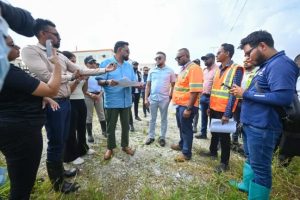
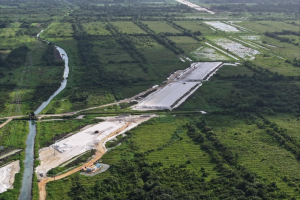
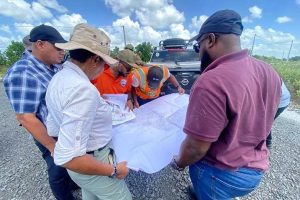
His Excellency President Irfaan Ali’s flagship developmental project, Silica City, is advancing rapidly amidst palpable excitement among the Guyanese people. For decades, Guyanese have yearned for planned development and concrete action to match the post-independence rhetoric of “moving inland.” In many ways, Silica City represents a multi-generational dream that is finally on the cusp of reality.
The systemic challenges facing Georgetown as the nation’s capital are both long-standing and well-documented. Guyana’s coastal plain, including Georgetown, sits below mean sea level and is perpetually at the mercy of the elements—particularly severe pluvial precipitation. As a tropical polder system, the northern South American coast battles an exceptionally heavy annual precipitation rate of 2,387 mm. This creates a relentless, dual-front conflict requiring constant defense not only against sea and river surges but also against vast volumes of freshwater draining from the Amazonian hinterland highlands. Consequently, the survival of these coastal hubs hinges on a vulnerable network of dikes, canals, mechanical pumps, and dams.
Following independence in 1966, Georgetown’s development became increasingly haphazard, allowing the historic, structural legacy of the plantation canal system to atrophy. Across the capital and the Greater Georgetown area, buildings were permitted in critical low-lying locations that should have been reserved for water-retaining ponds or drainage canals. As secondary canals were filled in for construction, the city became acutely susceptible to flash flooding and prolonged inundation. Compounding these systemic drainage failures is the perpetual political tussle between central and municipal governments.
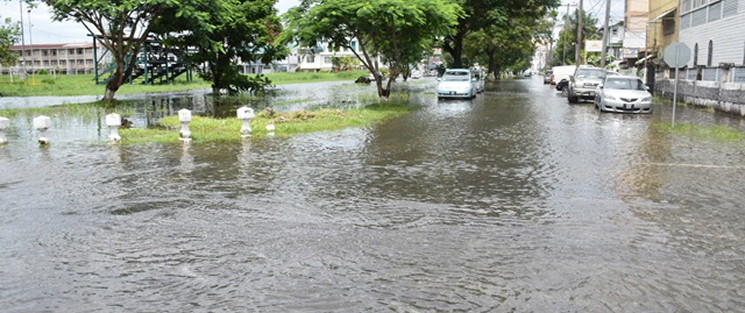
Floods Strike in Georgetown and Northern Regions of Guyana
The true frontier for Guyana’s development has always pointed inland toward higher ground—where flooding is no longer an existential threat and vast tracts of virgin land offer a blank canvas for meticulous urban planning. This is where Silica City begins: a new dawn for Guyanese development. While the hinterland can still experience localized flash flooding, building a planned city from scratch mitigates these hydrological risks. Crucially, the government’s ambition to move inland does not equate to the abandonment of the coast. These paths are complementary rather than mutually exclusive. The coastal plain remains rich in fertile alluvial soil, hosts vital natural seaports, and houses the vast majority of the population. Moving new developmental frontiers inland reduces capital development costs, protects fertile coastal lands from urban exhaustion, and allows for their reallocation toward large-scale commercial agriculture—effectively engineering the best of both worlds.
Academia, urban planners, and political leaders have widely supported this inland shift. Professor Jay Mandle of Colgate University noted in Guyana’s Choice: Petroleum and Climate Change in the Future that “if the Guyanese Interior is to become a new location of economic activity, it will only occur if the government leads the way.” We agree with Professor Mandle’s assessment. The government must act as the primary catalyst, just as the Belizean government did when it established its new inland capital, Belmopan, in 1967 following the devastation of Belize City by Hurricane Hattie. The Belizean government offices immediately relocated to the new capital upon completion of its first phase in 1970 to anchor the city. Similarly, higher education followed this administrative shift; the University of Belize eventually consolidated its primary central campus and administrative headquarters in the new capital to solidify its role as a national hub.
Silica City represents far more than a mere urban center; it symbolizes a country striving for a new developmental paradigm. Building inland means that public administration, residential housing, and civic services will diversify away from the narrow coastal strip. This optimization of land use means extremely fertile coastal soils can be dedicated entirely to agriculture, reviving another post-independence dream: transforming Guyana into the “West Indian Bread Basket.”
Furthermore, Silica City introduces new opportunities for housing development that will inspire a necessary cultural shift. Current coastal housing is constrained by an alluvial soil profile and a high water table, which significantly limits building heights to one or two stories without exorbitant foundation costs. Moving to Silica City’s superior soil profile unlocks vertical density, reducing the structural price per square foot. However, the authors encourage the central government to ensure that apartment complexes are spacious and conducive to healthy family life, avoiding the claustrophobic urban planning mistakes of the Soviet Union and mitigating the demographic vulnerabilities facing modern global societies.
Using a cluster development model, Silica City goes beyond conventional urban planning by designing a self-sustaining economic ecosystem built to endure for centuries. The fundamental driver of inland migration is not merely physical connectivity, but economic viability; affordable housing must be paired with modern amenities and robust employment opportunities. By establishing specialized districts for banking and finance, housing, government administration, and manufacturing, the city will naturally attract global investors.
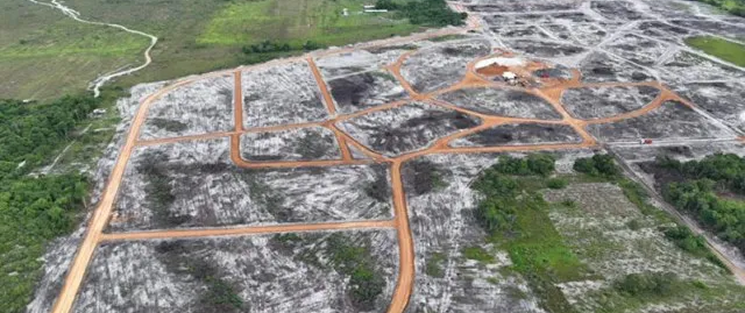
Silica City construction site / homes underway
To anchor this economic ecosystem, the authors strongly recommend that the government establish a new, primary campus for the University of Guyana within Silica City. Integrating a major university student body will inject a vibrant, youthful atmosphere and generate a persistent economic stimulus. Advanced training centers for healthcare, tourism, and professional services would serve as welcome, complementary additions.
Finally, the authors urge the government to approach the broader technical expansion of the city with long-term foresight. Because Silica City enjoys unconstrained spatial vectors, expansion can occur seamlessly. The highest priority should be bridging the geographic gap between the city and nearby waterways to eventually connect the inland capital to a dedicated port system. Integrating an active port and waterfront properties would elevate Silica City to a world-class urban center with no equal in the Caribbean.
Silica City is more than a flagship project for the presidency. It represents the future of Guyana—a nation realizing a multi-generational, post-colonial dream and translating economic rhetoric into physical reality. Ultimately, it signifies the pride and ambition of a nation striving to bridge the gap between itself and the developed world.